By Allan Pang
Malaysian Chinese Cultural Society,
‘Memorandum on National Culture’, 1983
馬來西亞華人文化協會,國家文化備忘錄,1983
For illustration purposes only. Original text in Mandarin.
Translation by Allan Pang.
We have to recognise and accept an indisputable fact: Malaysia is a multiethnic, multicultural, and multi-religious country. This is not only an objective truth but also the essence of independent Malaysia’s constitution. Rukun Negara, which is the compass of the nation’s foundation, also recognized this point. […]
Unfortunately, even today, when at least half of the [Malaysian] Chinese were born after independence, there were still people treating the group as ‘a migrant community’… Even more unfortunately, national cultural policies reflect these irrational and impractical views and practices. Therefore, we must confidently point out that today’s Malaysian Chinese culture is de facto local culture. It is definitely not the so-called ‘migrant culture’ […]
Language
According to the census in 1970, our country has at least 32 different ethnic groups and languages. We have to recognise this multiethnic and multi-linguistic situation as a fact and recognise their right to use and learn their mother tongue…
In a multiethnic and multi-linguistic nation, learning multiple languages, studying various dialects, translating documents, and translating literary works are very important tasks.
The government can establish a school on language, literature, and translation for all Malaysian ethnic groups and foreigners living in the country. It can provide the following services:
(a) Teaching the National Language, English, Mandarin, languages and dialects of Malaysia’s ethnic groups, Japanese, Thai, Korean, French, German, Vietnamese, Russian, etc.
(b) Translate official and private documents, train talents in translation and interpretation, and
(c) Provide translation service to publishers, scholars, or private sectors.
Radio and television stations should equally broadcast in different ethnic group’s languages. The shows must also reflect each group’s cultural features…
Since the 1950s, language has been a contentious issue in public policies in Malaya (later Malaysia). Various groups, especially from the local Chinese community, pushed for the inclusion of mother tongues at all levels of the national education system.
The government, on the other hand, had different plans. As part of its postcolonial nation-building efforts, the government introduced new plans to manage Malaysia’s multilingual reality. Dewan Bahasa dan Pustaka (DBP) was instrumental in shaping a monolingual identity by making Malay (Bahasa Malaysia) the national language. Later in 1971, the National Culture Policy doubled down on this, promoting a singular vision of the nation rooted in ‘indigenous’ (read: Malay) culture and Islam.
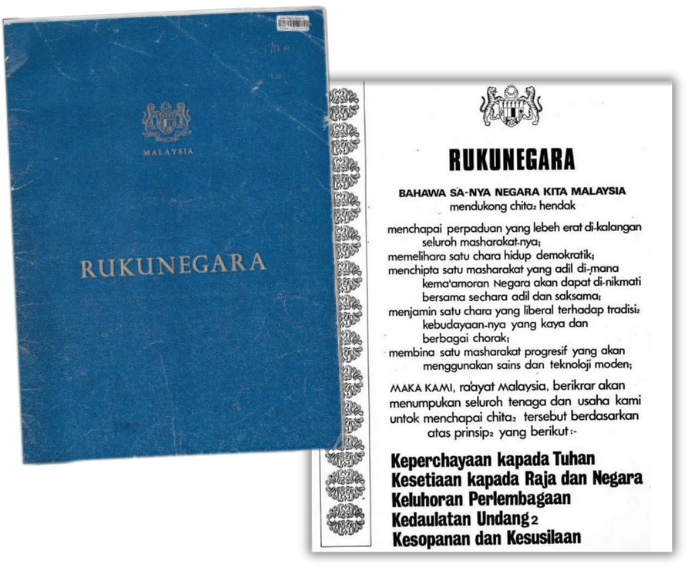
(L) The Rukun Negara declaration published on Merdeka Day in 1970, distributed to and displayed in all official institutions, departments, and agencies.
But not everyone was on board with this approach. By 1977, the Malaysian Chinese Cultural Society (part of the broader network of Chinese associations, or huatuan 華團) emerged as a vocal opponent. In 1983, they took a bold step by publishing a memorandum that openly called on the government to embrace the nation’s multilingual and multicultural reality.
The document argued that Malaysia wasn’t just about one culture or one language. Rather, over time, transnational cultures had become part of Malaysia’s local identity. The Society even cited the Rukun Negara (National Principles)—the official ideology advocating for national unity—to make their case for linguistic and cultural diversity in Malaysia.
That said, it’s worth noting that while the memorandum called for greater recognition of all cultures, its main focus was still on Chinese language and identity—true to the Society’s founding aims.
Further reading
Rachel Leow, Taming Babel: Language in the Making of Malaysia (Cambridge University Press, 2016), Chapter 5.