
By William Tham and Brendan Yeo
Source: National Archives of Malaysia
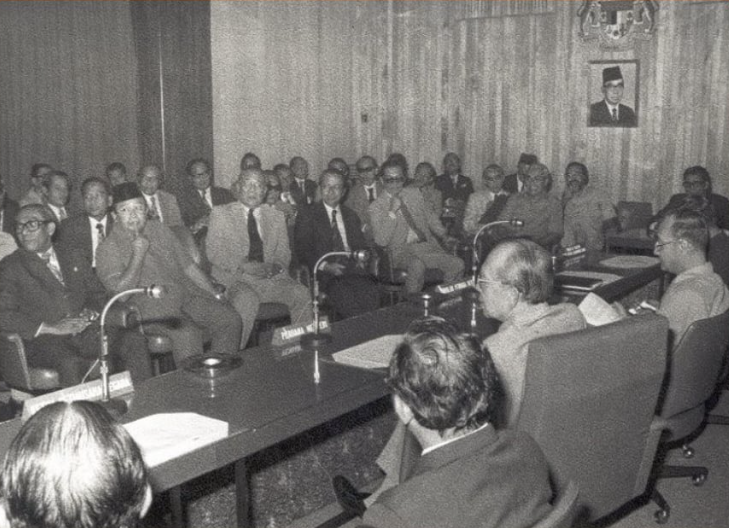
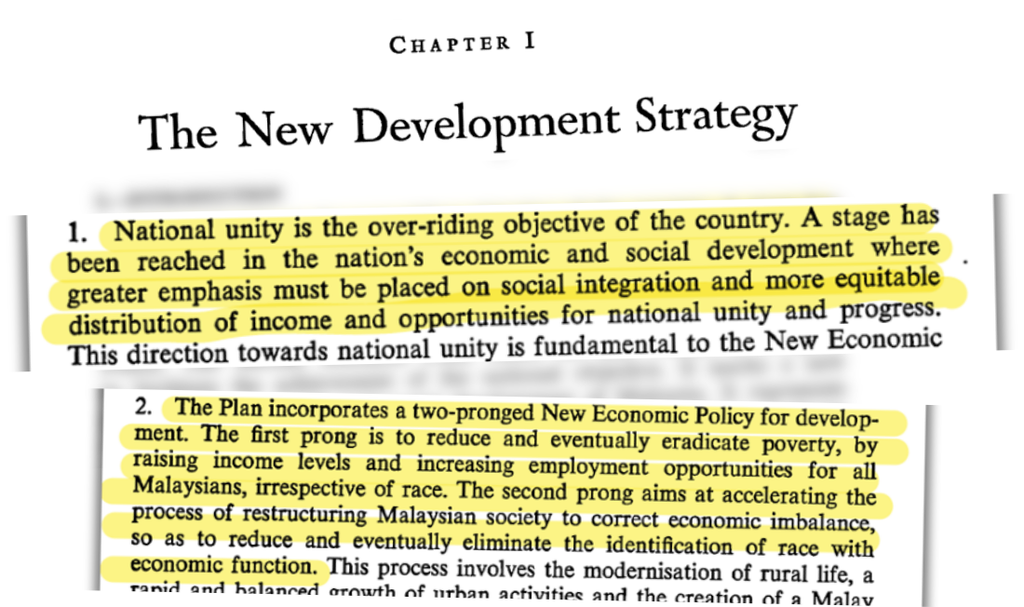
The New Economic Policy (NEP) was the cornerstone of national reconstruction from 1971 to 1990. But the policy’s transnational components remain obscure.
Beyond the national perspective that emphasises the racialisation of governance, what do the NEP’s transnational aspects tell us about Malaysia’s experience with decolonisation?
Source: Second Malaysia Plan, 1971–75, p.1
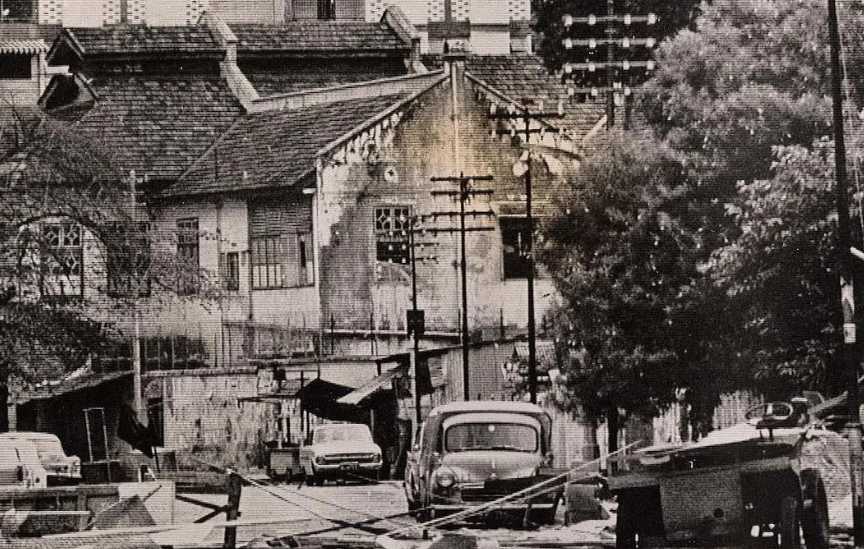
Shaped by the Japanese occupation during the Second World War, Malay nationalism later became central to Ghazali’s account of the NEP’s origins. The 13 May 1969 Incident, alongside growing interracial tensions, further created an urgent need for national reconstruction. In response, the unelected National Operations Council (1969–71) sought to restructure Malaysian society through greater state intervention in the economy.
Source: Berita Harian SG
Source: FOKUS
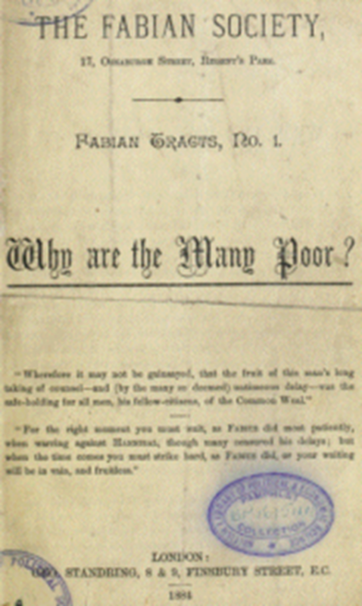
Malaysia’s second Prime Minister, Tun Abdul Razak Hussein, was often associated with the NEP and known as its founder. With an aristocratic background and links to the Fabian Society and the British Labour Party, Tun Abdul Razak Hussein was popularly described as sympathetic towards the rural poor.
Tun Abdul Razak wasn’t the only one influenced by Fabian socialism, an ideology that originated from Victorian-era democratic socialist movements advocating for reform rather than revolution. Prominent Malayan figures such as Lee Kuan Yew from Singapore were also influenced by Fabian socialism during postwar decolonisation.
The transnational influences did not stop with Tun Razak. The Kerala-born James Puthucheary, who helped found Singapore’s Barisan Sosialis before settling in Kuala Lumpur, had advocated state intervention in the postcolonial economy.
Apart from that, Harvard’s (liberal capitalist) Malaysia Advisory Group, led by the Norwegian economist Just Faaland, advised the Economic Planning Unit. The Bumiputera Economic Congress even promoted the Meiji-era zaibatsu model starting from the mid-1960s, to encourage state-driven economic growth.
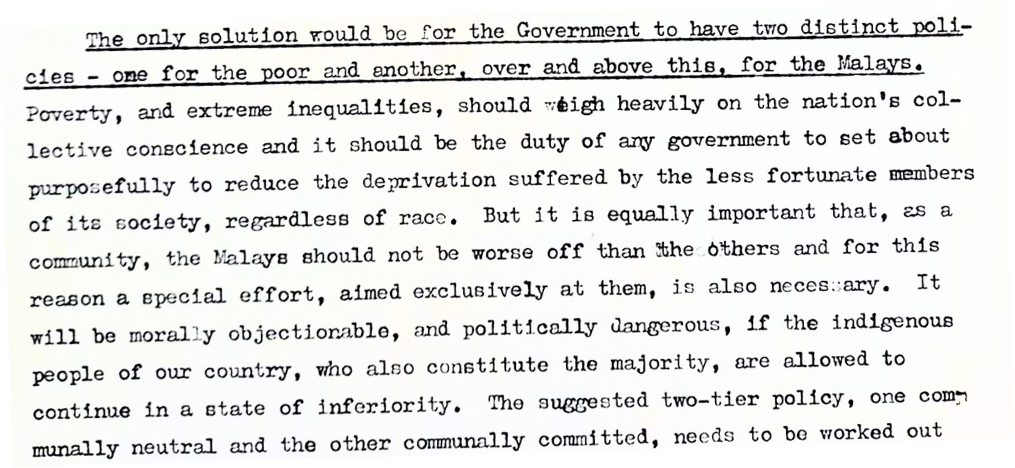
Another crucial consultant was the Kuala Lumpur-born Professor K.J. Ratnam, who initially lectured at the University of Singapore following the Separation in 1965. In written correspondence with Ghazali Shafie in 1970, he argued the need for a socioeconomic compromise as Malaysia returned to (limited) democracy. He proposed two approaches: poverty eradication for all and affirmative action for the Malays. Through these approaches, Ratnam offered a practical solution for a country which he viewed as deeply divided between communities.
Source: Personal correspondence between K.J. Ratnam and Ghazali Shafie [unpublished]
Cold War rivalry between the capitalist and communist blocs also shaped the creation of the NEP. Malaysia still pursued a future as a developmental state despite aligning with the capitalist Euro-American bloc, departing from the liberal democratic model. Across Asian postcolonies, authoritarian governments were actively intervening in order to maintain capitalist systems. At the same time, Tun Abdul Razak further improved diplomatic ties with the People’s Republic of China in 1974. This shows how postcolonial governance in Malaysia took a pragmatic approach that blurred ideological lines.
Due to the NEP, Malaysia and Singapore went on different national paths. Political rivalry between the two nations had already led to Singapore’s separation from Malaysia in 1965, and the NEP further worsened the rift between the two states.
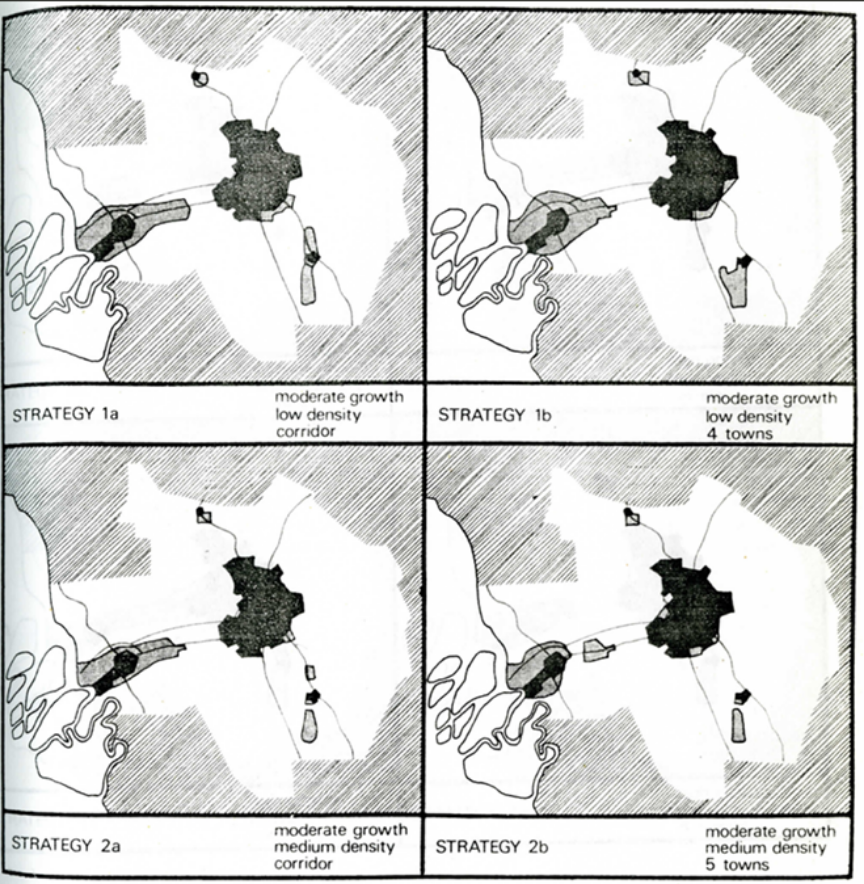
For example, British consultants from Shankland Cox & Associates planned the Klang Valley around the Kuala Lumpur–Port Klang axis. This gave the Klang Valley greater national importance and, in many ways, replaced Singapore’s earlier role as the main economic and cultural hub of the Malay Peninsula.
Regional Planning and Development Study.
Built on technocratic governance models, the NEP continued a trend that began with the National Operations Centre. Established in the early post-independence period, the Centre served both as a practical instrument and a diplomatic showcase for foreign heads of state, including the Shah of Iran.
Later, Malaysia’s perceived success in government-led reconstruction helped inspire post-Apartheid South Africa’s economic reconstruction. Notably, the Black Economic Empowerment programme, launched after Apartheid to promote wider participation of Black South Africans in the economy, took inspiration from the NEP.
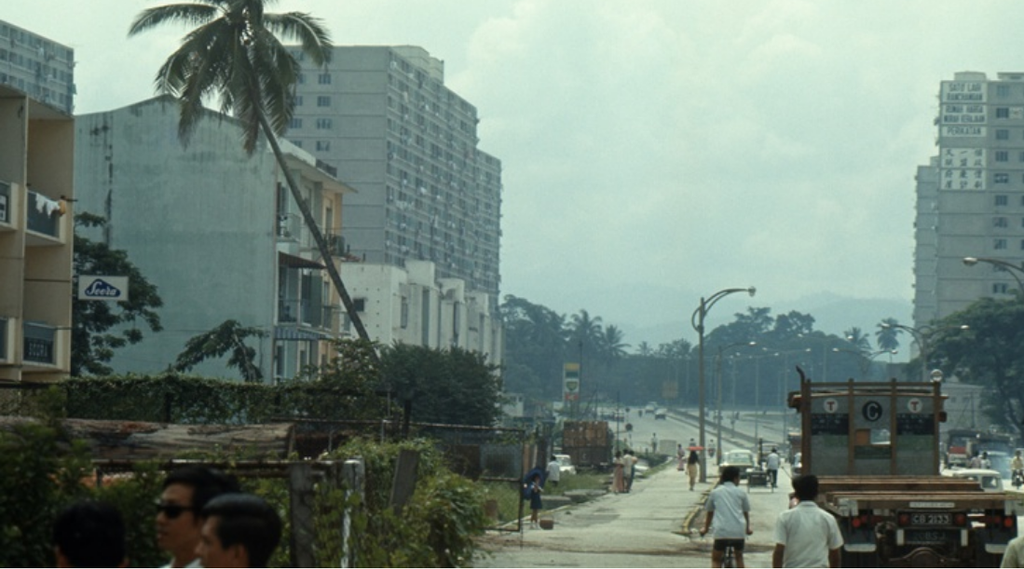
A transnational reading of the NEP shows that a policy which shaped Malaysia’s political economy was also rooted in a wider global history of decolonisation and the Cold War. The NEP can be viewed as an aspirational national pursuit or a reminder of the difficulties in forging nationhood from a plural society, especially in reimagining the economic bases of Malaysia from 1971 onwards. Ultimately, the exchange of ideas and influences from beyond Malaysia’s borders made this possible.
Source: Unidentified.
FURTHER READINGS
Choong, C. W. W. (2024). Anti-colonial raced capitalism in Malaya: Contested logics, gendered repertoires. Review of International Studies, 1–20.
Ghazali Shafie. (2002, September 9). “Tan Sri Ghazalie Shafiee [sic]: Interview by Tan Sri Dr Kamal Salih” [unpublished, collection of the Malaysia Design Archive].
Lee, Hwok-Aun. (2022). “Malaysia’s New Economic Policy: Fifty Years of Polarisation and Impasse.” Center for Southeast Asian Studies, II(2), pp. 299–329.
Ratnam, K.J. (1970, November 25). [Personal correspondence between KJ Ratnam and Ghazali Shafie] [unpublished, collection of the MDA].
Tham, Wai Liang, and Varkkey, Helena. (n.d.). “The Klang Valley as an infrastructure of Malay(si)an modernization, 1950s–70s.” Singapore Journal of Tropical Geography (in-press).