
Research By Allan Pang
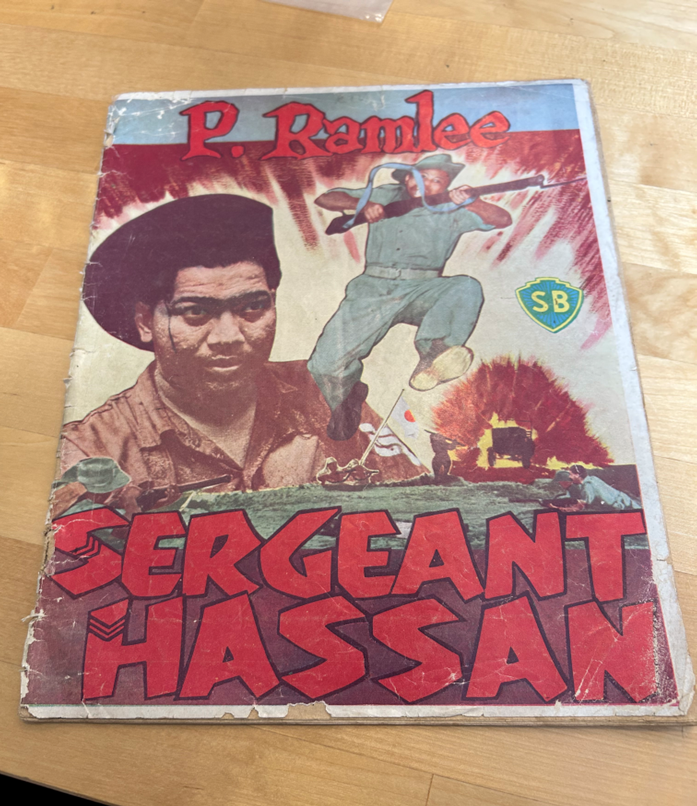
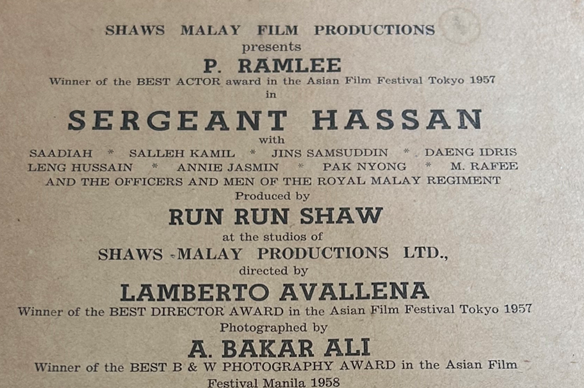
In August 1958, the Shaws Malay Film Productions released a new film, Sergeamt Hassan, featuring P. Ramlee. Like many other Malay-language films of the era, this production had an ethno-national focus emphasising the Malays in Malaya. As Ralph Modder, author of the story, wrote for a promotional brochure,
‘[T]he story… is based on fiction, but it symbolises the fighting spirit and gallantry of the men of the Malay Regiment who fought and died when the Japanese invaded Malaya, proudly upholding their tradition “Ta’at dan Setia” which means Loyal and True’.
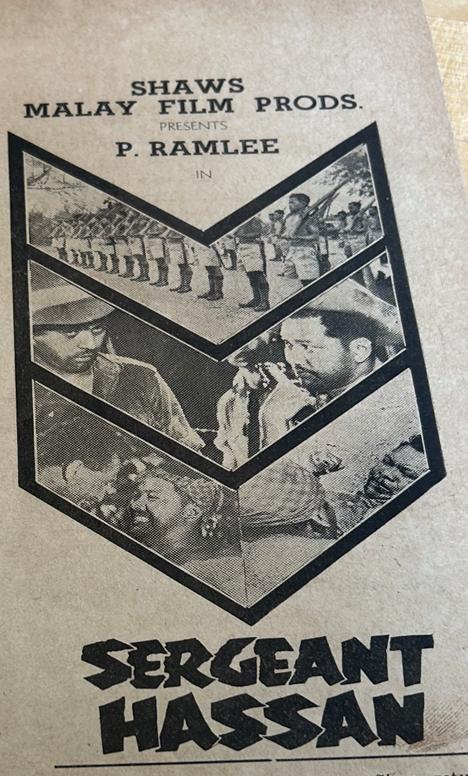
The brochure, which introduced the film in English and Malay (both Rumi and Jawi), proudly presented P. Ramlee as a national artist of Malaya.
‘P. RAMLEE. Seniman, biduan, pengarah, penggubah lagu… pemuda kebangaan Malaya, beraksi dengan dui hadiah2 Festival yang dimenanginya.’
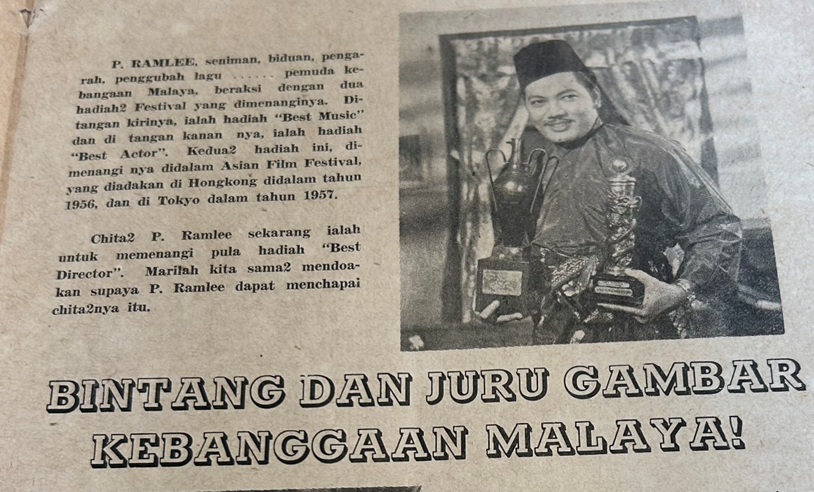
This brochure published in 1958 may give us some clues to challenge this ‘national’ image of the production. This Malayan film was first released in Singapore, but its production was transregional in origin. It was produced by filmmaker Run Run Shaw under the Shaws Malay Film Productions. We nowadays tend to think about the Shaw Brothers as a Hong Kong-based company producing Chinese-language movies. Nevertheless, the Shaw Brothers once owned important Malay film production studios. From the 1920s-30s onwards, Runme Shaw and Run Run Shaw produced not only Chinese but also Indian, Indonesian, and Western films with cinemas across Southeast Asia.
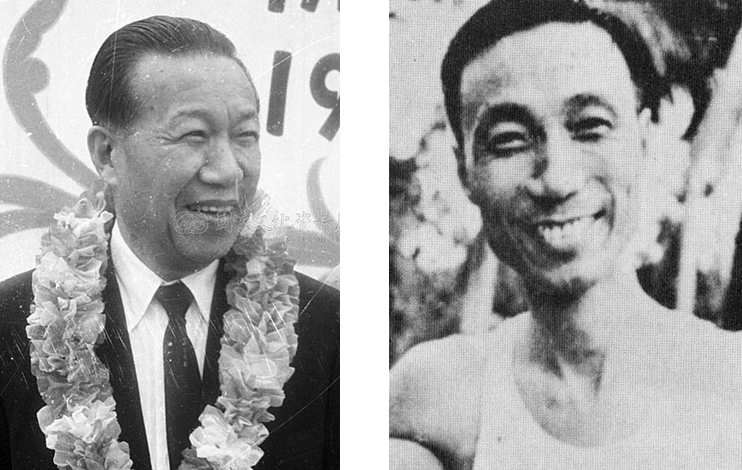
R: Run Run Shaw
Source: Wikipedia
•The production of Sergeant Hassan, like other Shaw movies, also utilised the company’s transregional ties. As the brochure introduced, the production involved not only P. Ramlee and Run Run Shaw but also people across the region.
‘Mr. Shaw, after several conferences, decided that the best man to direct the picture would be Lamberto V. Avallena, of the Philippines. Avallena won the “Best Director” award at the Asian Film Festival in Tokyo in 1957 and had directed nine war pictures in the Philippines and in Korea.’
‘Mr. Shaw also reailsed that in filming “SERGEANT HASSAN” a tremendous amount of the explosions would be necessary. So, he sent for Crisanto Hilario from the Philippines to supervise the explosions in the battle scenes…’
•Was the role of P. Ramlee in Malay-language cinema simply national? The early cooperation between P. Ramlee and the Shaws Malay Film Productions paved the way for him to develop his career beyond Malaya and Southeast Asia. In 1962, P. Ramlee had a guest appearance in Love Parade, a Shaw production in Hong Kong. He hoped to bring Malay filmmaking to Hong Kong because of the Shaw Brothers’ internationalist vision and their technologies. In other words, his vision for the Malay cinema went beyond the ethnonational discourse in Malaya, with the desire to raise its status internationally beyond Malay-speaking audiences.
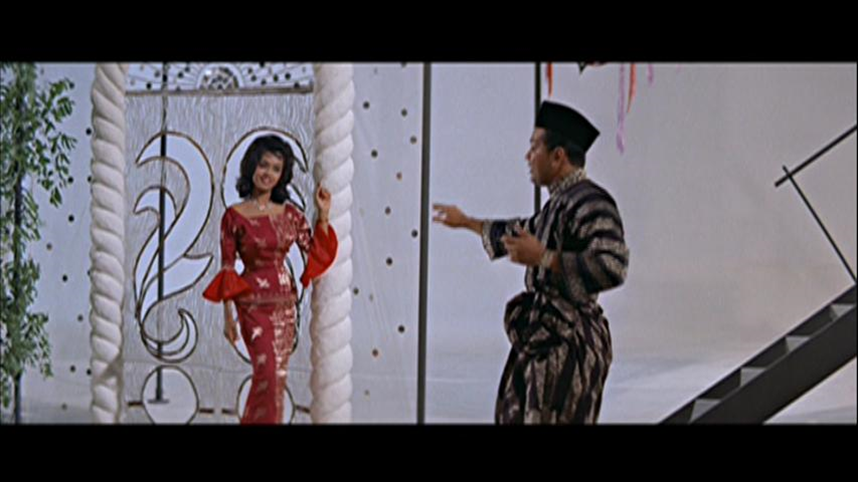
Source: IMDb
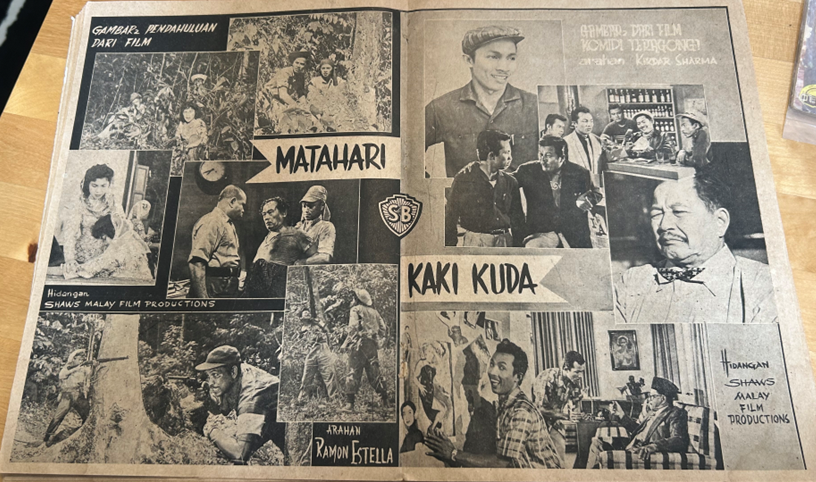
•P. Ramlee did not realise his transnational vision of the Malay cinema, as the mainstream production remained ethnonationalist afterwards. However, this transregional episode of Malay film production was also significant in the way of challenging late British colonialism. Through art, literature, and popular culture, the late colonial government of Malaya tried to develop an Anglicised vision of Malayan identity. However, this colonial culture failed to take root in the Malayan public. Cultural products beyond the English language, including transregionally produced Malay films, continued to receive popularity in postcolonial Malaysia.
Further Readings
- Yeo Min Hui, ‘Transnationalising Malay Cinema: P. Ramlee in Hong Kong’, Journal of Southeast Asian Studies 55, no. 1 (2024): 145-69.
- T. N. Harper, The End of Empire and the Making of Malaya (Cambridge: Cambridge University Press, 1999), chapter 7.
- This week’s historical document is kindly provided by Malaysia Design Archive.**